
Yorba Linda City Directory Collections and Coverage
Yorba Linda’s historical shelf is a mix of local memory, county-wide reference books, newspapers, census schedules, and land records. The Janss townsite dates to 1908 and 1909, so a long, standalone Yorba Linda city directory run should never be assumed. Research did not locate an authoritative catalog that lists exact publishers and year runs for physical Yorba Linda reverse or city directories, and no verified local sample entry was found. The table separates collections that are documented from the local volume details that still need a librarian’s shelf check.
| Collection | Years/era | Where held | Access |
|---|---|---|---|
| YLPL local-history photographs and stories | Rancho era through the twentieth century | Yorba Linda Public Library | Free online; names, places, and dated clues |
| Yorba Linda Star | Publication began 1917; microfilm gaps unverified | YLPL and newspaper databases | Library research; notices, clubs, addresses, and obituaries |
| Ancestry Library | Database-dependent | YLPL Digital Library | In-library use; indexed census and directory material |
| Fold3 Plus | Current library subscription; access ends December 1, 2026 | YLPL Digital Library | In-library use while available |
| Federal census | Decennial schedules through 1950 are public under the 72-year rule | NARA, FamilySearch, and library databases | Households, relationships, ages, places, and occupations |
| Orange County directories | 1913 to 1940 | Los Angeles Public Library Central Library | Orange County coverage, not verified Yorba Linda-specific coverage |
| Recorder deeds and maps | County formation and predecessor references forward | Clerk-Recorder and OC Archives | Title parties and legal descriptions |
| Historic Property Survey | Community development eras | Yorba Linda city records | Property names, construction context, and research leads |
| Yorba Cemetery | Established 1858; closed 1939 | County and library historical resources | Burial and family-network evidence |
Library reference staff can verify whether a physical local volume, reverse book, or telephone book is actually on a shelf. The documented contact is Yorba Linda Public Library, 4852 Lakeview Avenue, 714-777-2873. A request for a call number or publisher should be framed as a shelf-verification question, not as proof that a named volume exists.
Note: The Orange County rows show useful coverage, but they do not turn an Orange County directory into a verified Yorba Linda local run.
Why Yorba Linda Directories Start Late
A local directory needs more than a place name. It needs settled addresses, a way to reach households, and enough recurring civic life for a publisher to gather names. Yorba Linda’s own chronology explains why early searches must widen their frame. Janss laid out the townsite in 1908 and 1909. Telephone service arrived in 1911. The post office and Pacific Electric connection followed in 1912, the library began in 1913, and the Yorba Linda Star began in 1917. Incorporation did not occur until 1967.
| 1908–1909 | Janss townsite dates and subdivision activity make a local address trail plausible. |
|---|---|
| 1911 | Telephone service adds a reason to look for early telephone-book evidence. |
| 1912 | The post office and Pacific Electric service strengthen the town’s own mail and travel identity. |
| 1913 | The library begins, creating a local institution that can preserve later reference material. |
| 1917 | The Yorba Linda Star supplies a local newspaper trail for names, clubs, notices, and obituaries. |
| 1967 | Incorporation marks the start of a city government record layer, while county custodians still hold land, court, vital, and election records. |
The official Yorba Linda history gives the civic timeline that keeps a directory search from starting at an invented year.
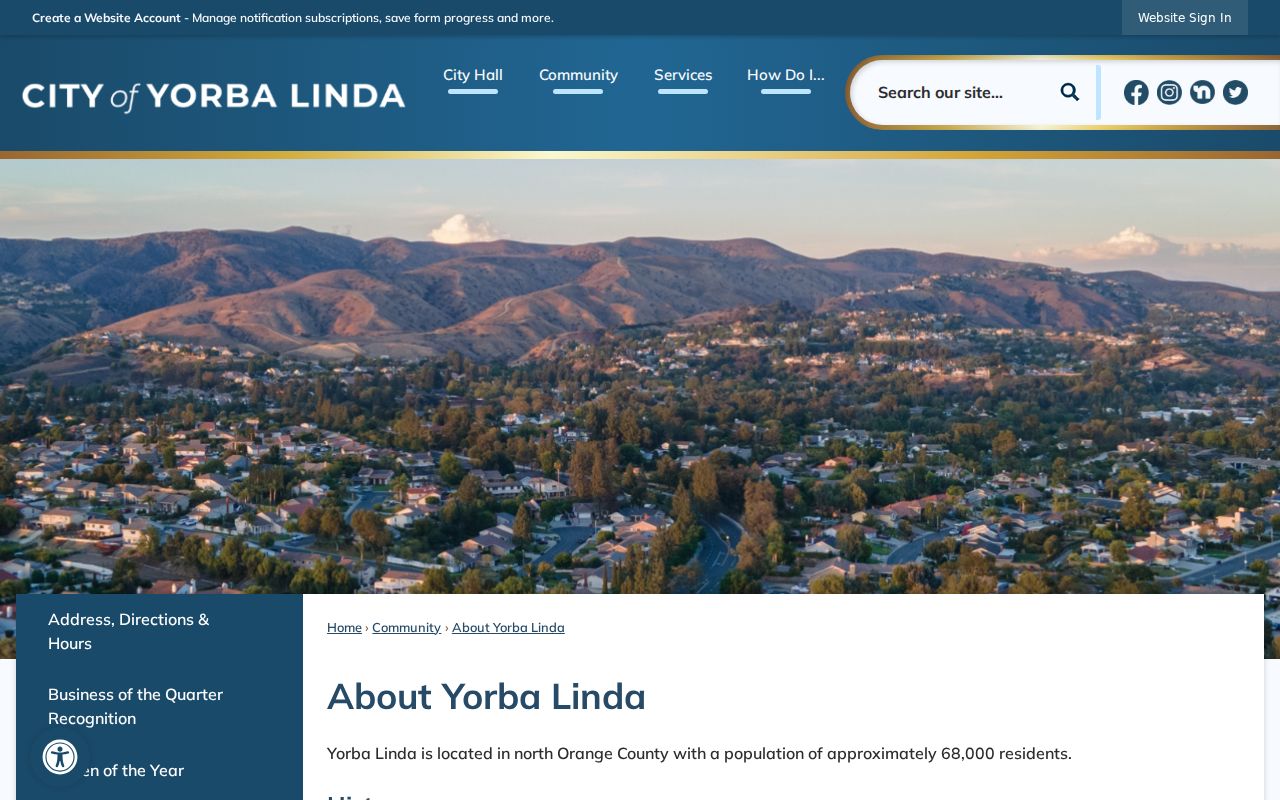
That history image is useful context for matching a dated volume to the town’s growth, but it is not a scan of a directory entry.
Yorba Linda Library Routes to City Directories
The YLPL local-history collection is free to browse online and brings together photographs and stories about people, institutions, and changing places. It can put a name beside a building or a dated landscape clue. Yorba Linda’s Digital Library lists Ancestry Library for in-library use and Fold3 Plus for library access, with the Fold3 subscription ending December 1, 2026. Those databases may contain indexed census, directory, military, or related material, but database coverage is not the same as a verified local printed run.
Yorba Linda’s genealogy guide recommends a broad name search first, then narrowing by place or middle name, and recording the source used. That order matters in Yorba Linda because a person may appear under a wider Orange County place label, an initial, a spouse’s name, or a neighboring city. A visit or phone call can answer the shelf question that an online catalog does not. The reference desk remains the best route for checking a physical reverse directory, microfilm, or a local-history photograph not exposed in a search box.
The Yorba Linda city department directory is a separate municipal contact tool. It helps identify the right city division for a public archive or historical-property question, while the library remains the local research contact for the historical shelf.
The department image shows an official contact route, not a household roster. Use it to distinguish municipal records from library-held historical collections.
Local quirk: the early library rules charged borrowers 50 cents a year, allowed two books for one week, and set a two-cent daily overdue fee. That small detail helps date the institution’s early community role.
Note: Fold3 Plus is a time-sensitive library access point, so a search planned after December 1, 2026 needs a different collection check.
Orange County Directories for Yorba Linda
Los Angeles Public Library’s Central Library holds Orange County directories dated 1913 through 1940, according to the Yorba Linda historic-property research. That is valuable regional coverage, but it must be labeled exactly that way. The source does not verify a Yorba Linda-specific publisher, a complete local run, or an entry for a particular street. Older volumes may place a small agricultural town inside a county or nearby-city section rather than grant it a separate heading.
Use the Orange County material as a wide net. Search the surname, then try the place name, neighboring city labels, and the likely address order. Pair a hit with the Yorba Linda Star, a census schedule, a tract map, or a recorded deed. Anaheim, Fullerton, Placentia, and Orange references can be useful comparison points, but they should not be relabeled as Yorba Linda coverage. A missing local heading is evidence of a boundary or catalog issue, not proof that no family lived there.
The Yorba Linda Archive Center is another browse point for posted municipal records. A missing document should lead to a focused request naming the department, date range, address, project, or record type. It should not lead to an invented directory title.
The Yorba Linda archive image reinforces the difference between a city document repository and a commercial or unverified directory claim.
Decoding a Yorba Linda Directory Entry
No authoritative open scan of a Yorba Linda-specific entry was found. The following is a reading key for a typical period volume, not a verified local sample. Read the page legend before expanding an abbreviation, and record the volume, page, publisher, place label, and source institution with every note.
| Surname and given name | The main alphabetical key; try initials and spelling variants when OCR fails. |
|---|---|
| Spouse notation | A spouse may appear in parentheses or under a separate entry, but no local format is verified. |
| Occupation or business line | A period field that can help distinguish people with the same name. |
| Home address | The street clue; compare it with the period map, tract, or legal description. |
| Residence marks | “r” may mean residence and “h” may mean householder; confirm each volume’s key. |
| Widow notation | “wid” may identify a widow through a spouse name, but it is a clue rather than proof. |
| Business listing and address | A separate listing can connect a name to a place without proving a home address. |
| Owner or renter mark | Some publications distinguish residence types; no Yorba Linda symbol or run was verified. |
- Criss-cross directory
- An address-order section that lets a search move from a street or house number to a listed householder, when the volume includes one.
- Householder index
- A name or address aid centered on the person treated as the household head, not a complete list of every person in the home.
- Abbreviation key
- The volume’s legend for marks such as r, h, and wid; photograph or transcribe it before reading entries.
- OCR absence
- A search miss may reflect poor scanning, a spelling variant, a boundary gap, or a missing year; browse nearby alphabetic pages.
The safest phrasing for a family-history note is “the volume lists” rather than “the family lived there.” When a directory name needs a modern identity check, the Yorba Linda resident lookup can shift the question to current official records. The second claim still needs a confirming source.
Yorba Linda Reverse Directory Clues
A reverse or criss-cross search starts with an address instead of a surname. It can be the fastest way to test a house history when the family name is unknown, misspelled, or indexed under a spouse. Yet the research did not verify exact Yorba Linda reverse-directory years, publishers, or a local sample. Ask YLPL reference staff whether a particular book is held, then note its actual geographic scope before using it.
If a volume is available, begin with the abbreviation key and the street-order pages. Check the target number, nearby entries, and both sides of a corner or private road. Compare the result with a tract map, assessor parcel, newspaper notice, or census location. A rural description may not match a later tract address, and a skipped year can make a household seem to vanish.
When the book is not on the library shelf, use the local-history photographs, the Star archive, Orange County directories, and OC Archives instead. Those sources can supply the date or name needed to return to a broader directory search.
Note: A reverse-directory reference is useful only after its place coverage and publication year are verified; an unverified title should never become a cited local fact.
Pair Yorba Linda Directories With Family History
Federal census schedules through 1950 are currently public under the 72-year release rule. A census gives a household snapshot, while a nearby directory or telephone book can fill the years between decennial schedules. The best result comes from pairing the two rather than treating either source as a complete resident list. Yorba Linda’s library search guide supports broad names first, place or middle-name narrowing next, and source citation throughout.
- Choose a public census year and write down the household’s names, ages, relationships, birthplace, occupation, and location.
- Search the nearest directory or telephone-book issue with the broad surname and first name, then narrow by Yorba Linda or an Orange County place label.
- Browse alphabetic pages around the expected name and inspect address-order pages when the scan or OCR misses the entry.
- Compare the address with a deed, APN, tract map, newspaper item, or local-history photograph; record what each source actually proves.
- Repeat for the next census or directory year, then cite the collection, issue, page, and access route in the family notes.
An absent name can mean a move, death, a boundary outside the publisher’s area, a spouse-index choice, a skipped volume, or a scan error. It does not by itself prove that a household was absent from Yorba Linda.
Yorba Linda Star and Directory Clues
The Yorba Linda Star began in 1917, close to the town’s early telephone and library era. Newspaper notices can add the human detail a directory lacks: a club role, a sale, a school event, a social visit, an obituary, or a business name tied to a street. The library’s local-history material also names Bernardo Yorba, Gertrude Welch, Julia Vernon and the Woman’s Club, the Nixon family, citrus growers, and packing-house workers.
Use a Star item as a dated lead. An obituary can suggest relatives and a last known place, while a society notice can distinguish two people with the same surname. Verify the address with a census, deed, parcel record, or another issue. Microfilm gaps are unverified, so a quiet year may reflect missing holdings rather than a quiet town.
These named collections also show why a directory is only one layer of a Yorba Linda resident trail. Local photographs, credited captions, and newspaper columns can bridge a name to a landmark even when the exact volume or publisher remains unknown.
Yorba Cemetery and Yorba Linda Family Trails
Yorba Cemetery predates the Janss townsite. It was established in 1858, closed in 1939, and is reported to include more than 400 Yorba family members and friends. Marker loss, theft, and vandalism complicate a simple walk-through search, and county custody means that surviving stones are only one part of the record.
Pair cemetery clues with obituaries, church records, probate files, census schedules, and the library’s local-history stories. A burial entry can connect a family group, but it may not name the address where a person lived. The absence of a marker is not proof that a person was never in the community. Ask the library or county historical resource for the source behind a burial count or place description.
Local quirk: a cemetery founded in 1858 can lead a searcher toward rancho-era kinship records long before a Yorba Linda directory could plausibly exist.
Packing-House History in Yorba Linda Directories
Local history can explain why a name appears in a newspaper, directory, or census without a clear modern address. A 1929 fire destroyed the wooden packing-house building and 103,000 fruit boxes. A concrete replacement opened in 1930 at 19200 Yorba Linda Boulevard. The dates and fixed place give a researcher a strong anchor for citrus growers, packing-house workers, family notices, and photographs.
Use the address as a landmark clue, not as a claim that every worker lived there. Search the Star, census schedules, deed and tract material, and YLPL photographs for names tied to the facility. The same method works with the Friends Church on School Street, the early library, and other sites preserved in local-history narratives.
For a person found in a directory, the packing-house story can supply context for a move or occupation. It cannot replace a dated entry or prove a household relationship. Keep the directory citation, the local-history source, and the independent confirmation side by side.